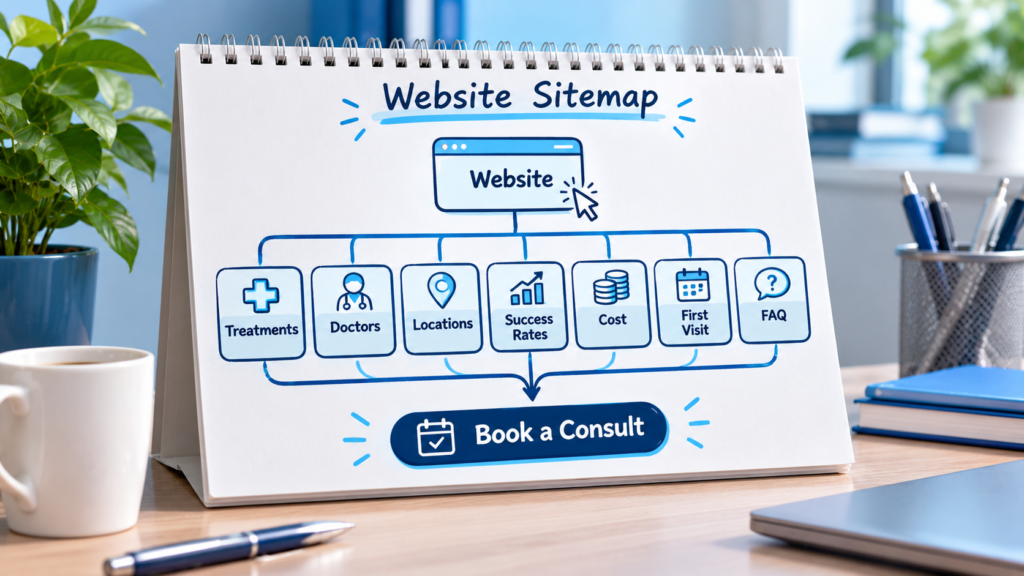
SEO for fertility clinics starts with seven pages: treatment pages, physician bios, location pages, a success rates page, a cost and financing page, a first consultation page and an FAQ hub. Each one answers a question patients search before they book.
Most agency guides on search engine optimization (SEO) list tactics. At Adlooper Fertility, we plan SEO for independent US fertility clinics page by page, in the order patients ask their questions.
Below you’ll find what each page must include, a summary table, and which page to build first.
Why does SEO for fertility clinics start with pages?
SEO for fertility clinics works when each page on your site answers one question a patient asks before booking a consult.
Demand is real. In 2022, 457 reporting US clinics performed 435,426 assisted reproductive technology (ART) cycles on 251,542 patients (CDC National ART Surveillance, 2022 data). In a 2023 survey, 42% of US adults said they had used fertility treatments or knew someone who had, up from 33% five years earlier (Pew Research Center, 2023).
Those patients search with specific questions. A clinic site with one generic “Services” page can’t answer them all, so Google has little to rank.
| Page | Question it answers | What it must include |
|---|---|---|
| Treatment pages | Do you offer what I need? | Who it is for, the steps, a next step |
| Physician bios | Who will treat me? | Training, credentials, bylines on content |
| Location pages | Where are you? | Address and phone that match Google |
| Success rates | How does this clinic do? | A link to official reported data |
| Cost and financing | Can I afford it? | What affects cost, insurance, financing |
| First consultation | What happens first? | What to expect, what to bring, how to book |
| FAQ and education hub | What else should I know? | Short, direct answers to real questions |
1. One treatment page per service
A fertility clinic should have a separate page for each treatment it offers, because patients search for treatments by name.
A page for in vitro fertilization (IVF), one for intrauterine insemination (IUI), one for egg freezing and one for each other service gives Google a clear match for each search. It also lets the patient read only what applies to them.
For a real example of SEO and the funnel working together, see how we doubled leads for an IVF clinic.
What to do: List every service you offer. Give each one its own page with who it is for, the main steps and a clear next step.
2. Physician bio pages
Physician bio pages show patients and Google who stands behind a fertility clinic’s medical content.
Google’s guidance says its systems give even more weight to content with strong experience, expertise, authoritativeness and trust (E-E-A-T) for “Your Money or Your Life” topics such as health, and that trust matters most (Google Search Central, updated 2026). Google also strongly encourages accurate authorship information, such as bylines, where readers expect it.
What to do: Build one bio page per physician with training, board certification in reproductive endocrinology and infertility (REI) and areas of focus. Link each treatment page and article to the doctor who wrote or reviewed it.
3. Location pages that match Google Business Profile
Each clinic location needs its own page, with details that match its Google Business Profile exactly.
Google’s Business Profile guidelines say a practitioner in a public-facing role who can be contacted directly at the location should have their own profile, and a practitioner shouldn’t have multiple profiles for different specializations (Google Business Profile Help, current). The same guidelines ban marketing taglines and service details in the business name.
For a group with two or three locations, mismatched names, addresses or phone numbers between the site and Google are a common local SEO problem.
What to do: Create one page per location with the real business name, address, phone, hours and the doctors who see patients there. Check that each detail matches the Google Business Profile.
4. A success rates page
A success rates page tells patients where to find a fertility clinic’s official reported results, explained in plain words.
US fertility clinics report ART data to the Centers for Disease Control and Prevention (CDC), which publishes clinic-specific and national success rates (CDC ART Success Rates). Patients compare clinics, and a page that points to the official numbers builds more trust than a headline claim.
Presenting success rates is also covered by the advertising guidance of the American Society for Reproductive Medicine (ASRM) and the Society for Assisted Reproductive Technology (SART). Have your team check the wording before the page goes live.
What to do: Link to your clinic’s published data, explain what the figures mean, and avoid comparing your clinic to others.
5. A cost and financing page
A cost and financing page answers one of the first questions patients ask a fertility clinic: can I afford treatment here?
You don’t need to publish a price list. Explain what affects cost, which insurance plans you work with and which financing options you offer.
What to do: Write one page on cost factors, insurance and financing. End it with a link to book a consultation.
6. A first consultation page
A first consultation page lowers the fear of booking by showing patients exactly what happens at a fertility clinic’s first visit.
Knowing what to expect makes booking feel like a smaller step. A first consultation page sits at the bottom of the patient funnel, so it should make booking easy.
What to do: Describe the first visit step by step, list what to bring and add a booking button near the top and the bottom.
7. An FAQ and education hub
An FAQ and education hub lets a fertility clinic answer the many smaller questions patients search before and between visits.
Short, direct answers are easy for patients to read and easy for search engines and AI tools to quote. Each answer should link back to the matching treatment page.
What to do: Collect the questions your front desk hears every week. Answer each one in two or three sentences, starting with the direct answer.
Which page should you build first?
Most fertility clinics should build treatment pages and location pages first, because those pages match the searches closest to booking.
Physician bios come next, since every treatment page and article should link to one. The success rates, cost and first consultation pages then support the decision, and the FAQ hub grows over time.
If you want help planning these pages as part of a full patient funnel, see our 90-day patient acquisition program.
FAQ
How long does SEO take for a fertility clinic?
SEO for a fertility clinic has no fixed timeline. Results depend on your site’s current state, your competition and how consistently you publish and update pages.
Is local SEO different from SEO for fertility clinics?
Local SEO is one part of SEO for fertility clinics. Local SEO focuses on location pages and Google Business Profiles, while overall SEO also covers treatment pages, physician bios and educational content.
Do fertility clinics need a blog for SEO?
A fertility clinic doesn’t need a blog to start, but it does need an FAQ and education hub. Articles that answer real patient questions and link to treatment pages help those pages get found.
Next step
Start by listing the seven pages and marking which ones your site already has. The gaps are your SEO plan.
If you’d like a second set of eyes on your site and funnel, book your free funnel audit.